 Skip to Content

What Is a Commercial Litigation Claim? A Clear Guide
A commercial litigation claim is a formal legal dispute arising from a business relationship, where one party seeks damages or enforcement of rights against another. These claims cover everything from broken contracts to shareholder conflicts, and they carry real financial weight for everyone involved. Understanding what qualifies as a commercial claim, how the process works, and what laws govern it gives you a critical advantage before you ever set foot in a courtroom. This guide breaks down the commercial litigation definition, the most common claim types, and the practical steps you need to know.
What is a commercial litigation claim, exactly?
A commercial litigation claim is a lawsuit filed when a dispute arises from a business transaction or commercial relationship. The parties involved are typically businesses, partners, shareholders, or vendors, not private individuals in personal matters. The core issue is always tied to commerce: a contract gone wrong, a fiduciary duty violated, or a trade practice that caused financial harm.
Commercial litigation focuses on external business transactions and relationships, while business litigation tends to address internal operational disputes. That distinction matters because it shapes which legal forum applies and which strategy makes sense. A dispute between two companies over a supply agreement is a commercial claim. A dispute between co-founders over equity allocation is a business litigation matter.
The financial exposure in commercial claims is often significant. A single breach of contract can trigger losses in the hundreds of thousands or millions of dollars, depending on the deal size. That scale is exactly why these cases demand careful preparation and specialized legal knowledge from the start.

Common types of commercial litigation claims
Breach of contract is the dominant issue in commercial litigation, because contracts govern nearly every business relationship. When one party fails to perform, delivers defective work, or refuses to pay, the other party has grounds for a claim. The injured party can seek compensatory damages, specific performance, or both.
Beyond contract disputes, commercial claims cover a wide range of business conflicts. Here are the most common categories:
- Breach of contract. Nonperformance, late delivery, defective goods, or payment refusal. The most frequently filed commercial claim.
- Fiduciary duty violations. Officers, directors, and partners owe a duty of loyalty and care to the business. Breaching that duty, such as self-dealing or misappropriating funds, creates liability.
- Shareholder and partnership disputes. Conflicts over ownership rights, profit distributions, or governance decisions. The Business Organizations Code governs many of these disputes, including formation documents and ownership rights.
- Trade secret misappropriation. When a former employee or competitor steals proprietary information, formulas, or client lists, the injured business can sue for injunctive relief and damages.
- Unfair trade practices. Deceptive advertising, tortious interference with business relationships, and predatory pricing all fall under this category.
- Real estate and development disputes. Commercial lease disagreements, construction defects, and title conflicts are common in this space. You can learn more about how property damage claims work in complex disputes.
Pro Tip: Document every business communication from day one. Text messages, emails, and meeting notes become critical evidence in breach of contract and fiduciary duty claims.
How does commercial litigation differ from general civil litigation?
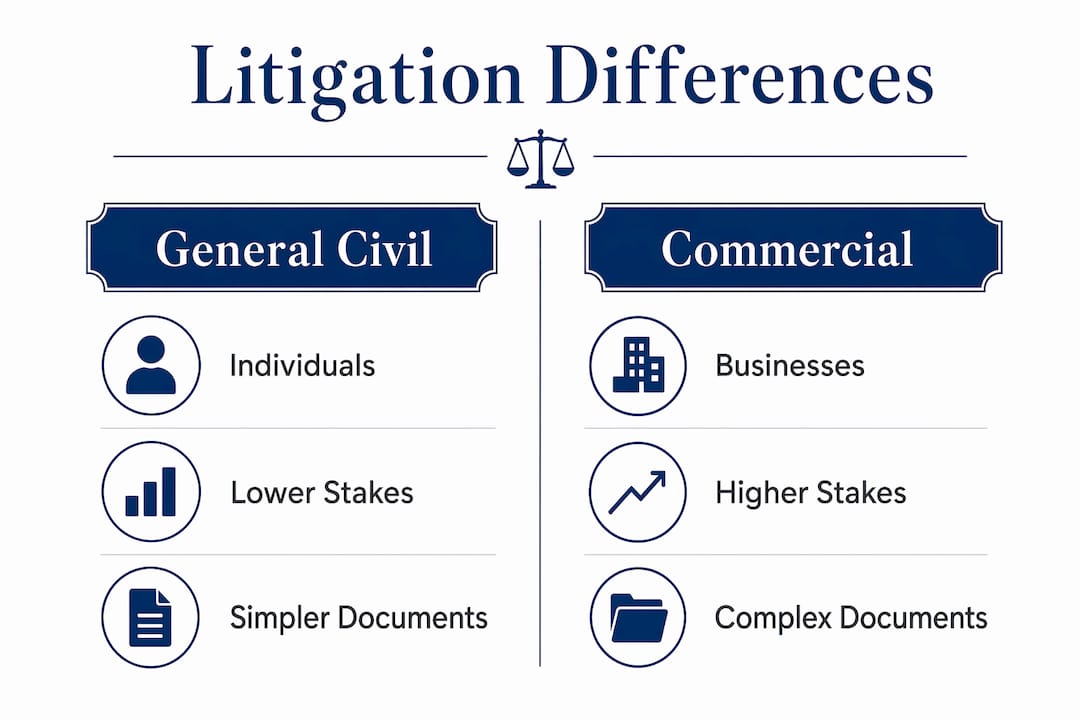
Commercial litigation involves higher financial stakes, more complex documents, and expert testimony that general civil cases rarely require. A personal injury lawsuit might hinge on medical records and witness accounts. A commercial dispute can involve thousands of financial documents, corporate governance records, and testimony from forensic accountants.
The table below captures the key differences between the two types of litigation.
| Factor | General civil litigation | Commercial litigation |
|---|---|---|
| Parties involved | Individuals, small disputes | Businesses, partners, shareholders |
| Financial stakes | Typically lower | Often very high |
| Documentation volume | Moderate | Voluminous, complex |
| Expert testimony | Rare | Common (forensic accountants, industry experts) |
| Court divisions | General civil courts | Specialized commercial divisions |
| Dispute resolution | Standard court process | Often includes arbitration or mediation first |
Multi-party involvement and specialized expert testimony distinguish commercial disputes from simpler civil cases. When a case involves three companies, two sets of contracts, and competing financial models, a general civil litigator is simply not equipped to handle it effectively. Commercial litigation demands deeper industry knowledge and courtroom experience with complex evidence.
Ignoring procedural nuances unique to commercial litigation can result in costly delays and a loss of leverage. Many commercial courts operate under distinct rules for discovery, motion practice, and case management. Missing a procedural deadline in a commercial division can be far more damaging than in a standard civil court.
Pro Tip: When selecting legal counsel for a commercial dispute, look specifically for attorneys with trial experience in commercial divisions, not just general civil practice. The procedural differences are significant enough to affect your outcome.
Legal frameworks and procedures governing commercial claims
State and federal laws both play a role in commercial litigation, depending on the nature of the dispute. Contract claims typically fall under state law, while disputes involving securities fraud, federal trade violations, or interstate commerce may trigger federal jurisdiction. Florida, for example, has specific statutes governing commercial leases, business organizations, and trade practices that apply directly to claims filed in the state.
Contracts themselves are the primary legal framework in most commercial disputes. Courts examine the contract language, the parties’ conduct, and any applicable industry standards to determine liability. Governance documents like operating agreements, shareholder agreements, and bylaws also carry legal weight, particularly in fiduciary duty and ownership disputes.
The typical stages of a commercial litigation claim follow this sequence:
- Pre-filing assessment. Evaluate the strength of your claim, identify the parties, and preserve all relevant documents and communications.
- Complaint filing. The plaintiff files a formal complaint in the appropriate court, stating the legal basis for the claim and the damages sought.
- Service and response. The defendant is served and files an answer or motion to dismiss within the court’s deadline.
- Discovery. Both sides exchange documents, take depositions, and gather evidence. This stage is often the longest and most expensive in commercial cases.
- Expert analysis. Forensic accountants, industry specialists, or technical experts are retained to support or challenge key claims.
- Motion practice. Parties file motions to narrow the issues before trial, including motions for summary judgment.
- Trial or settlement. Most commercial cases settle before trial, but cases with significant disputes over facts or law proceed to verdict.
Alternative dispute resolution methods such as arbitration are common in commercial claims and often required by contract before a lawsuit can be filed. Arbitration keeps disputes private and moves faster than court proceedings. Mediation, a non-binding process, gives both sides a chance to negotiate a resolution with a neutral third party.
Practical steps for filing and managing a commercial claim
The first step is determining whether your dispute actually qualifies as a commercial litigation matter. Ask whether the conflict arises from a business transaction, a contract, or a commercial relationship. If the answer is yes, and the financial exposure is material, you likely have a viable commercial claim worth pursuing.
Early case preparation separates winning claims from losing ones. Preserving communications and contract documents is crucial before filing, because clients often lose their advantage by mishandling evidence early. Collect every relevant email, contract, invoice, and meeting record before you contact an attorney. Once litigation begins, document preservation becomes a legal obligation.
Key steps for managing a commercial claim effectively:
- Assess your damages concretely. Quantify your financial loss before filing. Courts award damages based on provable harm, not general frustration.
- Engage specialized counsel early. Specialized counsel improves outcomes and reduces procedural errors. The earlier you bring in an attorney with commercial litigation experience, the better your position.
- Explore alternative dispute resolution first. Early negotiation can protect business viability better than aggressive litigation. A well-structured demand letter or mediation session can resolve a dispute in weeks rather than years.
- Manage your timeline and budget. Commercial litigation is expensive. Understand the likely cost range before committing to a full lawsuit, and discuss fee structures with your attorney upfront.
- Protect confidential information. If your claim involves trade secrets or proprietary data, ask your attorney about protective orders to prevent public disclosure during discovery.
Pro Tip: Never send a demand letter without attorney review. A poorly worded letter can undermine your legal position or trigger a counterclaim you did not anticipate.
Key Takeaways
A commercial litigation claim requires early evidence preservation, specialized legal counsel, and a clear understanding of the procedural rules that govern business disputes.
| Point | Details |
|---|---|
| Definition matters | A commercial claim arises from business transactions, not personal disputes, and demands a different legal approach. |
| Evidence is decisive | Preserving contracts, emails, and financial records before filing directly affects case outcomes. |
| Specialized counsel is critical | Attorneys with commercial litigation experience reduce procedural errors and improve results. |
| ADR comes first | Arbitration or mediation is often required by contract and can resolve disputes faster than court. |
| Stages are predictable | Knowing the litigation stages, from complaint to trial, helps you manage costs and set realistic expectations. |
What I’ve learned about commercial litigation that most guides won’t tell you
After years of watching commercial disputes unfold, the pattern I see most often is this: businesses wait too long and prepare too little. By the time a client calls, critical emails have been deleted, key witnesses have left the company, and the other side has already built their narrative.
The misconception that every business dispute requires immediate litigation is genuinely costly. Aggressive litigation risks public records that damage reputations and drive up costs for both sides. I have seen cases where a well-prepared demand letter and two mediation sessions resolved a $2 million contract dispute in six weeks. The client avoided two years of litigation, protected a key business relationship, and kept the dispute out of the public record.
The other thing I tell every client is this: your evidence tells the story, not your frustration. Courts respond to documents, timelines, and expert analysis. The business owner who kept meticulous records of every contract amendment and payment dispute walks into court with a real advantage. The one who relied on memory and verbal agreements walks in with a problem.
Commercial litigation is not something to fear. It is something to prepare for. The businesses that handle these disputes best are the ones that treat legal risk the same way they treat financial risk: with discipline, early attention, and the right professionals in their corner.
— Jorge
Calillaw’s approach to complex commercial disputes
Commercial litigation claims carry real consequences for your business, your finances, and your future. Calillaw is a Florida litigation firm led by a Board Certified Civil Trial Lawyer with decades of courtroom experience in high-stakes disputes.

Calillaw handles complex business litigation with the same disciplined preparation and trial-tested judgment it brings to every case. From evidence management and negotiation to full courtroom representation, the firm is built to protect clients when the outcome matters most. Whether your dispute involves a broken contract, a fiduciary violation, or a trade practice claim, Calillaw gives you the focused advocacy your situation demands. If you are facing a serious commercial dispute, explore how Calillaw’s litigation representation can work for you, and contact the firm for a consultation.
FAQ
What is the commercial litigation definition in simple terms?
Commercial litigation is a formal legal process where businesses or individuals resolve disputes arising from commercial transactions, contracts, or business relationships through the court system or alternative dispute resolution.
What are the most common types of commercial claims?
Breach of contract, fiduciary duty violations, shareholder disputes, and trade secret misappropriation are the most frequently filed commercial litigation claims.
How does the commercial litigation process start?
The process begins with a pre-filing assessment to evaluate the claim, preserve evidence, and determine the appropriate legal forum, followed by filing a formal complaint in the relevant court.
Is arbitration required before filing a commercial lawsuit?
Many commercial contracts require arbitration before court proceedings, making it a mandatory first step in a large share of business disputes.
When should you hire a commercial litigation attorney?
Engage a specialized attorney as early as possible, ideally before sending any demand letters, to protect your evidence, avoid procedural errors, and build the strongest possible case from the start.


