 Skip to Content

What Is a Breach of Contract Claim? Your Legal Guide
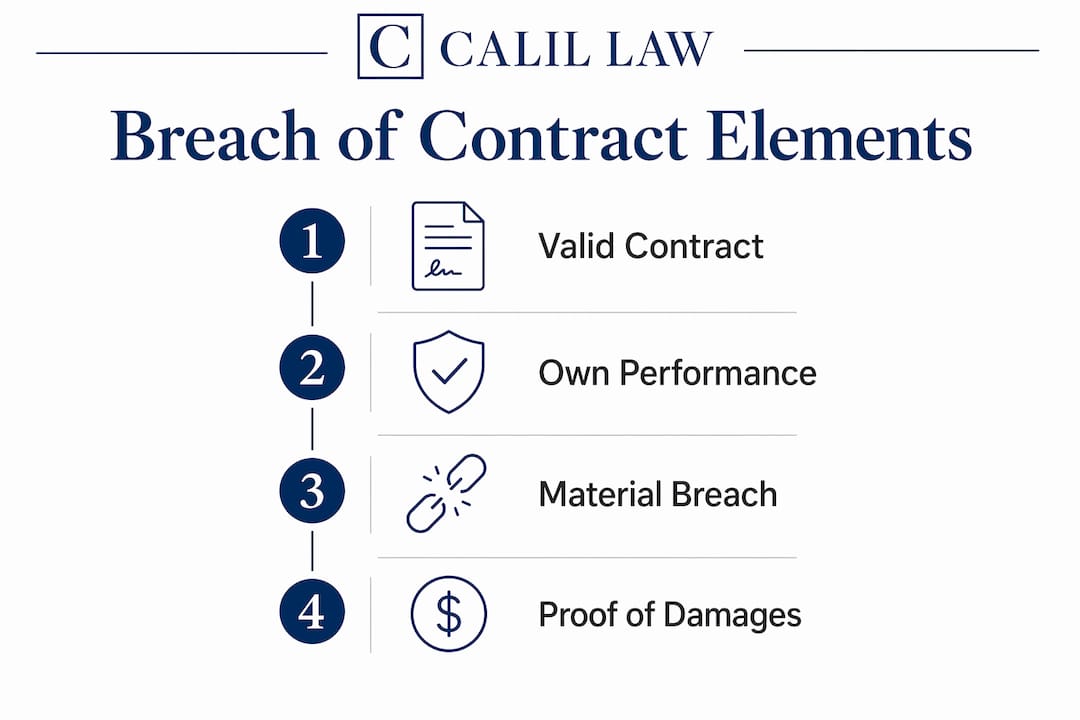
A breach of contract claim is a legal assertion that one party failed to perform their duties under a valid, binding agreement, causing measurable harm to the other party. Contract law does not exist to punish the party who failed. Its goal is to place the injured party in the position they would have occupied had the contract been fully performed. To succeed, you must prove four elements: a valid contract existed, you performed your own obligations, the other party committed a material breach, and you suffered real damages as a result. Understanding these elements is not just reassuring. It is the first step toward knowing whether you have a viable claim.
What are the four key elements of a breach of contract claim?
A breach of contract claim stands or falls on four specific legal elements. Failure to prove any single element causes the court to dismiss the claim entirely. Each element carries its own standards and common pitfalls.
Valid contract formation
A contract requires three things: an offer, an acceptance, and consideration. Consideration means each side gives something of value, whether money, services, or a promise to act. Verbal agreements can qualify as contracts, but written contracts are far easier to prove in court. Courts focus on objective evidence of contract formation and dismiss claims based on emotional harm or unbound promises that never formed a real agreement.

Your own performance
You must show that you fulfilled your own contractual duties before pointing to the other party’s failure. Litigation practitioners confirm that without proving your own performance first, breach claims are typically dismissed regardless of what the other party did wrong. If you had a valid excuse for not performing, such as the other party’s prior breach, you must document and plead that excuse clearly.
A material breach by the other party
Not every failure qualifies as a breach that justifies terminating a contract. A material breach defeats the contract’s main purpose and gives you the right to walk away and sue. A minor breach, by contrast, entitles you to damages but requires you to keep performing your own obligations. Stopping your own performance because of a minor breach can make you the breaching party and expose you to counterclaims.
Proof of damages
You must connect your losses directly to the breach. Courts require damage claims to be factually specific for compensation beyond nominal amounts. Speculative damages, meaning losses you cannot document or quantify, are regularly dismissed.
Pro Tip: Document every financial loss the moment a breach occurs. Receipts, invoices, emails, and bank records all strengthen your damages claim and reduce the risk of dismissal.
What are common types and examples of breach of contract claims?
Breach of contract claims fall into distinct categories, and the type of breach shapes your legal options significantly.
The three main breach types
- Actual breach. The party simply failed to perform when performance was due. A contractor who misses a project deadline without excuse has committed an actual breach.
- Anticipatory breach. The party announces in advance that they will not perform. Under anticipatory breach rules, you may sue immediately or wait until the performance date arrives. Waiting carries risk: if you cannot later prove an actual breach occurred, your recovery rights may be limited.
- Material versus minor breach. Only material breaches justify terminating the agreement. Minor breaches allow you to claim damages but require you to continue performing your own side of the deal.
Real-world examples across contract types
| Contract type | Example of breach | Likely classification |
|---|---|---|
| Employment agreement | Employer withholds agreed commission payments | Material breach |
| Residential lease | Landlord fails to make required repairs after notice | Material or minor, depending on severity |
| Service agreement | Vendor delivers work two weeks late but fully complete | Minor breach |
| Sales contract | Seller refuses to deliver goods already paid for | Material breach |
| Construction contract | Contractor uses lower-grade materials than specified | Material breach |
A common misconception is that any broken promise allows you to cancel the contract. The law requires a material breach for contract termination. If the breach is minor, you must keep performing and pursue damages through the courts. Misreading breach severity is one of the most costly mistakes a claimant can make.
What legal remedies are available for breach of contract claims?
Breach of contract law offers several distinct remedies, and the right one depends on what you lost and what the contract required.
- Compensatory damages. These cover your actual financial losses caused directly by the breach. Lost profits, additional costs you incurred to cover the failed performance, and out-of-pocket expenses all qualify. Breach claims arise across employment, leases, and consumer transactions, and remedies include monetary damages or specific performance depending on the situation.
- Special damages. Also called consequential damages, these cover losses beyond the direct value of the contract, such as lost business opportunities. Courts require these to have been foreseeable at the time the contract was signed.
- Nominal damages. When you prove a breach but cannot demonstrate a measurable financial loss, courts may award nominal damages to vindicate your legal rights. The amount is symbolic, but the legal recognition matters.
- Specific performance. A court orders the breaching party to fulfill their contractual obligations. This remedy applies most often in real estate transactions, where money alone cannot replace the unique property you were promised.
- Rescission. The court cancels the contract entirely and attempts to restore both parties to their original positions. This is appropriate when the breach is so fundamental that continuing the agreement makes no sense.
Pro Tip: If you are pursuing specific performance, act quickly. Courts are more likely to grant this remedy when you file before the breaching party has taken steps that make performance impossible.
Courts do not award punitive damages in standard breach of contract cases. The law’s focus is compensation, not punishment. Precision in calculating and documenting your losses is what separates a strong damages claim from one that gets dismissed or reduced at trial. For cases involving property damage claims, the same principle applies: documented, specific losses carry far more weight than general assertions of harm.
How do you file and prove a breach of contract claim effectively?
Filing a breach of contract claim requires more than telling a judge the other party let you down. Courts demand specific, documented allegations tied directly to contract language.
- Identify the exact contract provisions breached. Pull the contract and mark every clause the other party violated. Courts require specific factual allegations connecting the breach to named contract sections. Generic claims that “the defendant failed to perform” are routinely dismissed on motions to dismiss.
- Document your own performance. Gather every record showing you met your obligations: invoices paid, work delivered, communications sent, and deadlines met. Litigation practitioners confirm this step is non-negotiable. Without it, your claim fails before the other party’s conduct is even examined.
- Quantify your damages with precision. List every financial loss and attach supporting documentation. Speculative or vague damage claims give courts grounds to reduce or dismiss your recovery. A commercial litigation strategy built on documented losses is far more durable under cross-examination.
- Evaluate anticipatory breach timing. If the other party has already told you they will not perform, you have a choice. You can sue immediately or wait until the performance date. Suing immediately locks in your claim. Waiting keeps the contract alive but requires you to secure proof of actual breach if performance is ultimately refused.
- Avoid vague pleadings. The pleading stage is a major battleground. Thorough factual allegations matching contract terms to breaches and damages significantly improve your chances of surviving early motions and reaching trial.
Pro Tip: Before filing, send a formal written demand letter referencing the specific contract provisions and the exact dollar amount you are claiming. This creates a paper trail, demonstrates good faith, and sometimes resolves the dispute without litigation.
Key Takeaways
A breach of contract claim succeeds only when you prove all four elements: valid contract, your own performance, a material breach by the other party, and specific, documented damages.
| Point | Details |
|---|---|
| Four elements are required | Valid contract, own performance, material breach, and documented damages must all be proven. |
| Material breach matters | Only a material breach justifies terminating the contract; minor breaches require you to keep performing. |
| Damages must be specific | Speculative or vague damage claims are regularly dismissed; document every financial loss immediately. |
| Anticipatory breach creates options | You may sue immediately or wait, but waiting requires proof of actual breach to protect recovery rights. |
| Pleading precision is critical | Vague complaints are dismissed early; name the exact contract provisions and connect them to your losses. |
What I’ve learned about breach claims after years in the courtroom
The single most avoidable mistake I see claimants make is filing before they have documented their own performance. They are so focused on what the other party did wrong that they forget the court will ask them first: “Did you hold up your end of the deal?” If you cannot answer that question with records, your claim is already in trouble.
The second pattern I see constantly is treating every contract failure as a material breach. A vendor who delivers two days late has not necessarily given you grounds to terminate the agreement and sue for everything. Misclassifying a minor breach as material, then stopping your own performance, can flip the case against you. Suddenly you are the defendant.
Specificity in pleadings is where cases are won or lost before they ever reach a jury. I have watched well-founded claims get dismissed at the pleading stage because the complaint said “defendant failed to perform” without identifying a single contract clause. Courts are not sympathetic to vague grievances. They reward preparation.
My honest advice: if you believe you have a breach of contract claim, consult an attorney before you do anything else. The decisions you make in the first weeks, including what you say in writing and whether you keep performing, shape the entire case. Getting it right early costs far less than fixing it later.
— Jorge
How Calillaw can help you evaluate your contract dispute
Contract disputes carry real financial and legal consequences, and the outcome depends heavily on how the claim is built from the start.

Calillaw is a Florida litigation firm led by a Board Certified Civil Trial Lawyer with decades of courtroom experience. The firm handles complex commercial litigation matters and serious civil disputes, combining disciplined case preparation with direct client communication. Whether you are evaluating a potential claim or already facing litigation, Calillaw provides the trial-tested judgment your situation demands. The firm also represents clients in personal injury and insurance disputes where contract obligations are central to recovery. Contact Calillaw for a consultation and get a clear assessment of your legal position before the other side gains the advantage.
FAQ
What constitutes a breach of contract?
A breach of contract occurs when one party fails to perform a contractual obligation without a valid legal excuse. The failure must be material, or at minimum cause measurable damages, for a legal claim to proceed.
What is the difference between a material and a minor breach?
A material breach defeats the contract’s main purpose and allows the non-breaching party to terminate the agreement and sue for damages. A minor breach entitles the non-breaching party to damages but requires them to continue performing their own obligations.
Can you sue for anticipatory breach before the deadline passes?
Yes. When a party announces they will not perform before the performance date, the non-breaching party may file suit immediately. Waiting until the deadline passes is also an option, but it requires securing proof that an actual breach occurred.
What damages can you recover in a breach of contract case?
Courts award compensatory damages for direct financial losses, special damages for foreseeable consequential losses, and nominal damages when a breach is proven but no measurable loss exists. Punitive damages are not available in standard breach of contract cases.
How do you avoid having a breach of contract claim dismissed early?
Identify the exact contract clauses that were violated, document your own performance thoroughly, and quantify your damages with supporting records. Vague complaints that fail to connect specific contract provisions to specific losses are routinely dismissed on motions to dismiss.


